

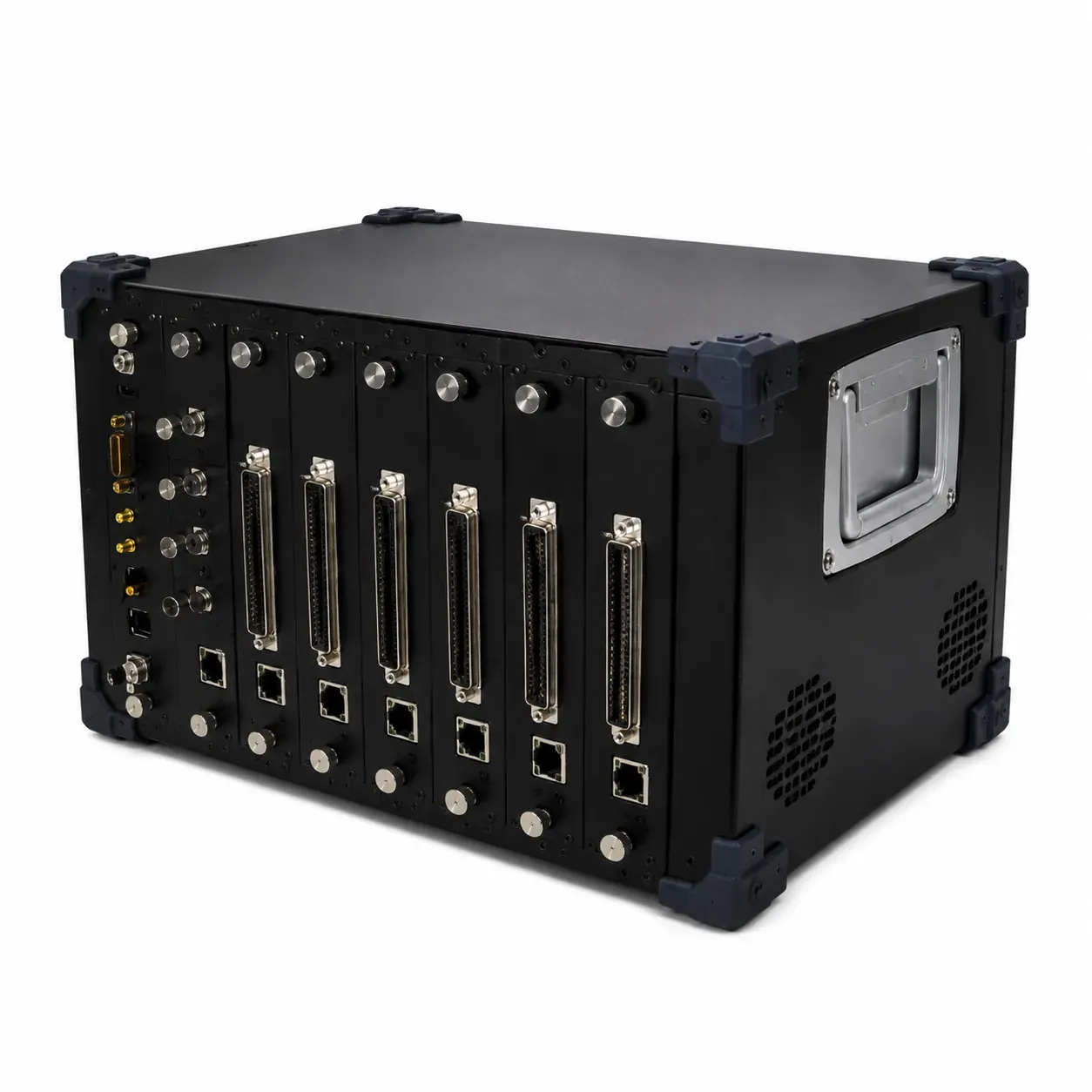
GUXI-1007
- 100% domestic chips, self-controllable
- Compact chassis + zero-slot control module + functional modules; cage structure with front-inserted, quickly swappable cards
- Every module can run inside the chassis or be detached for standalone use via its gigabit-Ethernet port
- Overall size kept within 300×200×200 mm for true portability
- Gigabit-Ethernet backplane bus supporting multi-module coordination, timing and synchronization
- Two 1394 nodes built into the zero slot, based on MIL-1394b / SAE AS5643, each with full CC / RN / BM capability
- Integrates 1553B / serial / CAN / AD / DA / DI / DO / PWM / resistance functional modules in one unit
- Wide-temperature components throughout, covering -20~60℃ and 0~85% humidity environmental requirements
Need selection advice or an on-site demo? Use the buttons above and our engineers will reach out shortly.
Specifications
| Item | Value | Note |
|---|---|---|
| System Specifications | ||
| Dimensions | ≤ 300×200×200 mm | |
| Architecture | Compact cage chassis + zero-slot control module + functional modules | |
| Modular Design | Front-inserted cards, hot-swappable for fast replacement | |
| Localization Rate | 100% | |
| Operating Temperature | -20℃ ~ 60℃ | Built with -40~85℃ wide-temperature components |
| Operating Humidity | 0 ~ 85% | |
| Zero-Slot Control Module & Backplane Bus | ||
| Backplane Bus | Gigabit Ethernet for high-speed data transfer | |
| External Gigabit Ethernet | No fewer than 2 ports | |
| 1394 Bus Interface | Two nodes built into the zero slot | See “Zero-Slot 1394 Bus” below |
| Signals over the Backplane | Power, command, synchronization and status signals unified over the backplane | |
| Multi-Module Coordination | Multi-module coordinated management with timing synchronization | |
| Standalone Module Use | Every functional module can be detached and run standalone over its gigabit-Ethernet port | |
| Zero-Slot 1394 Bus | ||
| Node Count | 2 nodes supported | Inside the zero-slot control module, not a separate card |
| Node Capability | Every node provides full CC, RN and BM capability | |
| Protocol Standard | Based on MIL-1394b, in standard SAE AS5643 protocol format | |
| Transfer Modes | S100B / S200B / S400B, selectable | |
| Port Mode | Beta mode | |
| Transfer & Monitoring | CC / RN node transmit and receive, plus BM bus monitoring | |
Optional modules
Configure this device with the functional modules below — click any module to view its specifications and detail.
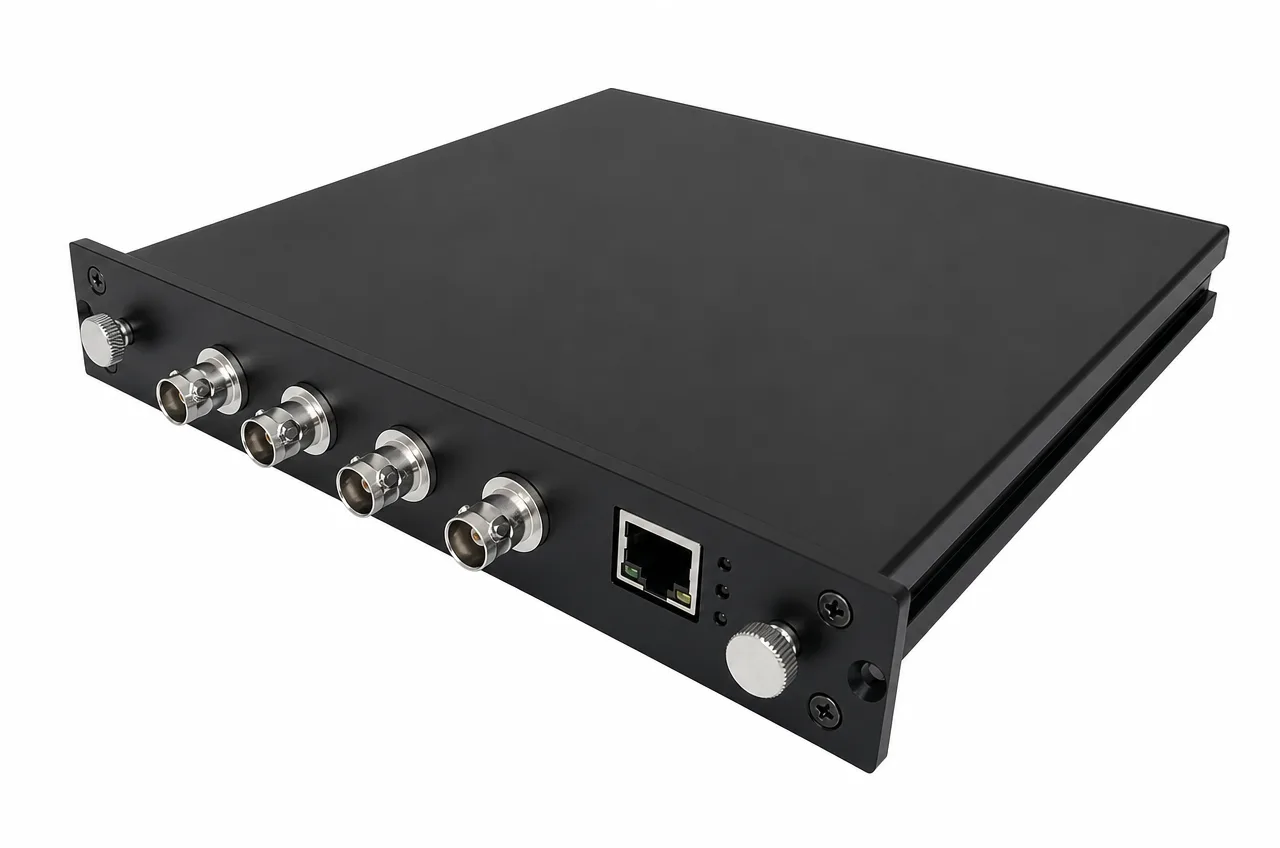
GJB289A (1553B) Bus Module
2 channels × 4 with dual-redundant transceivers, full BC/RT/BM, multi-cycle scheduling for RTs on differing periods
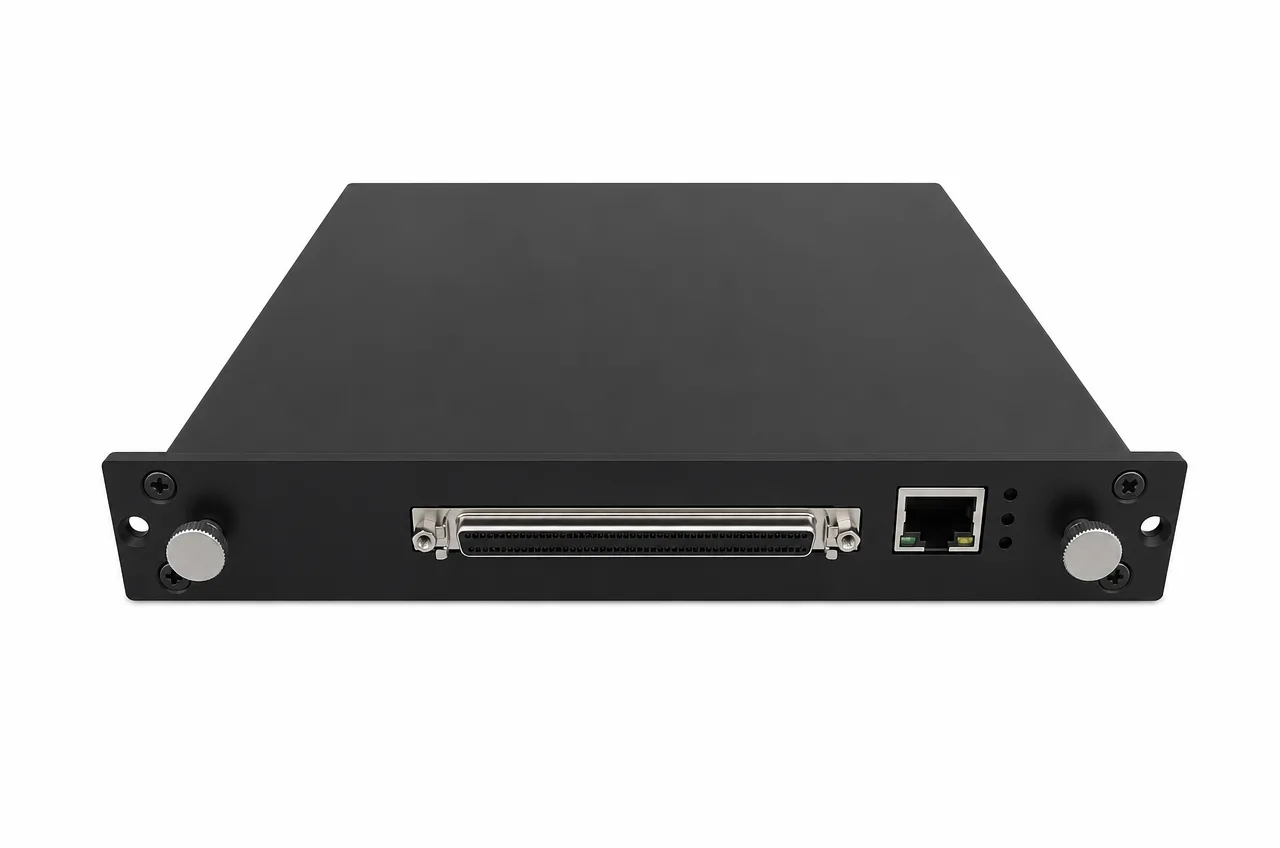
Serial / CAN Communication Module
16 serial ports switchable between 422/485/232 plus 4 CAN channels, with programmable serial↔CAN auto-forwarding and date-based on-board storage
AD Analog Acquisition Module
32 single-ended / 16 differential, switchable — 250 kS/s, 16-bit, ±10V, better than ±0.5%FS
DA Analog Output Module
16 single-ended / 8 differential, switchable — 100 kS/s/ch synchronous, 16-bit, ±10V, fixed and arbitrary waveforms
Resistance Acquisition & Simulation Module
12 three-wire PT1000 static-acquisition channels (800Ω~1600Ω, ±1%FS) plus 12 fixed 1KΩ simulation channels, with on-board storage and calibration
Digital I/O Module (DI / DO)
20 single-ended DI and 28 isolated DO channels, parameterized per 4-channel group, with programmable DIO auto-forwarding and two-bit IO status read-back
PWM / Pulse Module
4 simulation-output and 4 acquisition channels — 1V~28V amplitude, 1Hz~50KHz, 0~100% duty cycle at 0.1% resolution
Related scenarios
Downloads
FAQ
- Is the GUXI fully localized?
- The GUXI is designed entirely on domestic chips — 100% localized and self-controllable. Every functional module from the overall architecture down is implemented with mature domestic chips, with design verification ensuring multi-module coordination and synchronization meet requirements — suited to self-controllable avionics ground testing.
- Which signals and buses does the GUXI support?
- The platform is built as a zero-slot control module + backplane bus + functional modules. The zero-slot control module carries two built-in 1394 nodes (MIL-1394b / SAE AS5643, selectable S100B/S200B/S400B) and no fewer than two external gigabit-Ethernet ports. The functional modules cover 2 channels × 4 of GJB289A (1553B), 16× RS422/RS485/RS232 serial with 4× CAN on one module, 32 single-ended / 16 differential AD, 16 single-ended / 8 differential DA, 20× DI / 28× DO digital, 4× PWM simulation and acquisition each, and 12× PT1000 resistance acquisition and simulation each — combined to suit customized test plans.
- What are the GUXI’s size and environmental ratings?
- The unit is kept within 300×200×200 mm in a portable compact cage chassis. Wide-temperature -40~85℃ components throughout cover the -20~60℃ operating range and 0~85% humidity requirements; vulnerable areas receive conformal coating, with validation performed in a high/low-temperature chamber simulating real environments.
- Can GUXI-1007 replace HDAQ for shock-wave pressure acquisition?
- No. GUXI-1007 is supporting test & control equipment for synchronous multi-quantity signal acquisition and bus data monitoring; for high-speed transient acquisition such as shock-wave pressure choose the HDAQ series.