

Geotechnical Vibration Monitoring
Highlights
Reliable data foundation for blast vibration and geotechnical dynamics
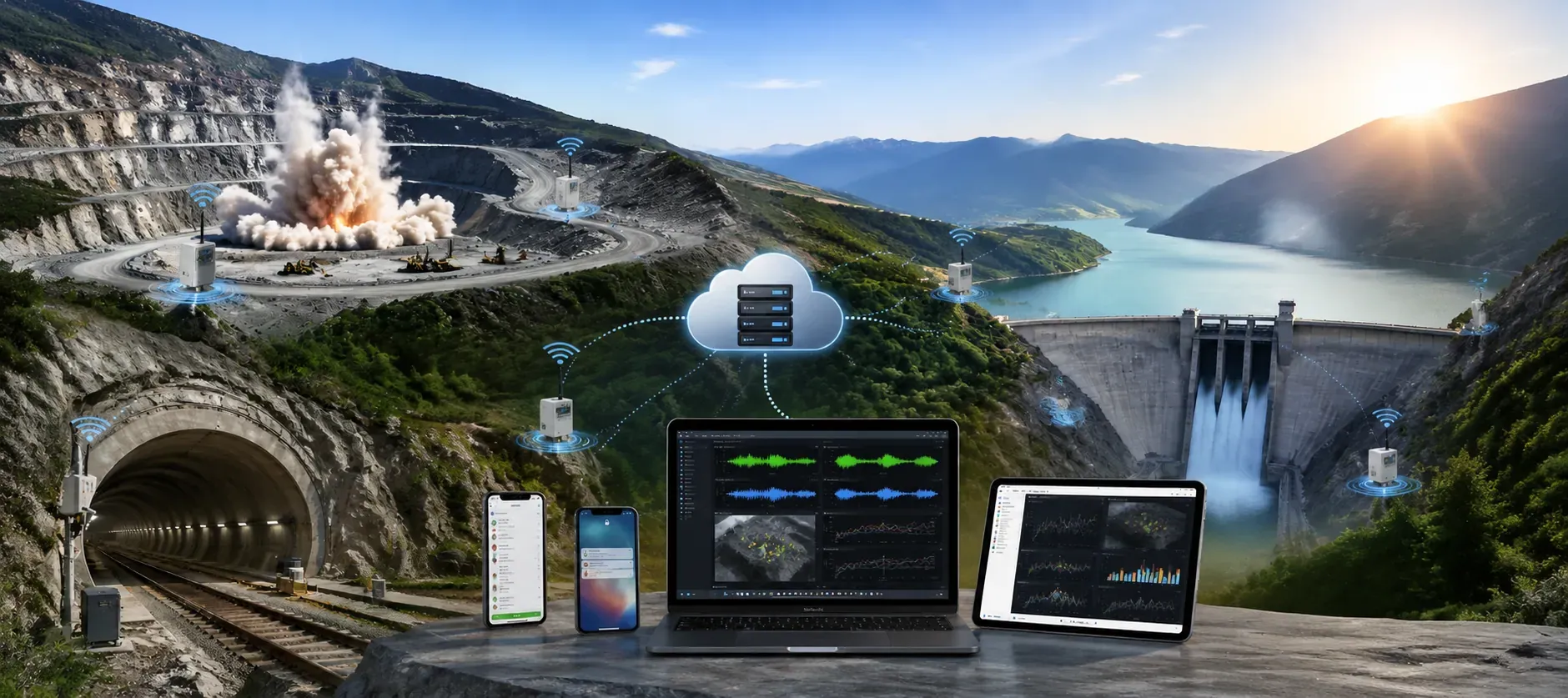
Designed for blast vibration monitoring and geotechnical dynamics research in tunnels, dams and mines. Integrates high-sensitivity geophones, multi-channel synchronous acquisition and intelligent analysis to deliver particle velocity, acceleration and displacement in real time — supporting safety assessment, slope-stability analysis and medium-parameter inversion.
Strong transient signals: blast particle velocity and acceleration peaks are large with steep rising edges, requiring a wide range without saturation and broadband response without distortion.
Wide frequency range: from low-frequency micro-vibration of dams to the kHz band of near-field blast shock, all must be covered uniformly.
Distributed multi-point synchronisation: slope, tunnel and dam monitoring needs tens to hundreds of synchronised points, with a microsecond-level time base for wave-velocity inversion and time-difference location.
One-shot test opportunities: a single blast cannot be reproduced, so pre-triggering and stable triggering directly determine success.
Harsh field conditions: construction sites bring dust, humidity, large temperature swings and unstable power, so measurement points need long field endurance and maintenance-free operation.
Reports feed safety reviews: data must support blast-safety assessment, slope-stability analysis and engineering review, demanding strong data traceability and standardised reporting.
System architecture
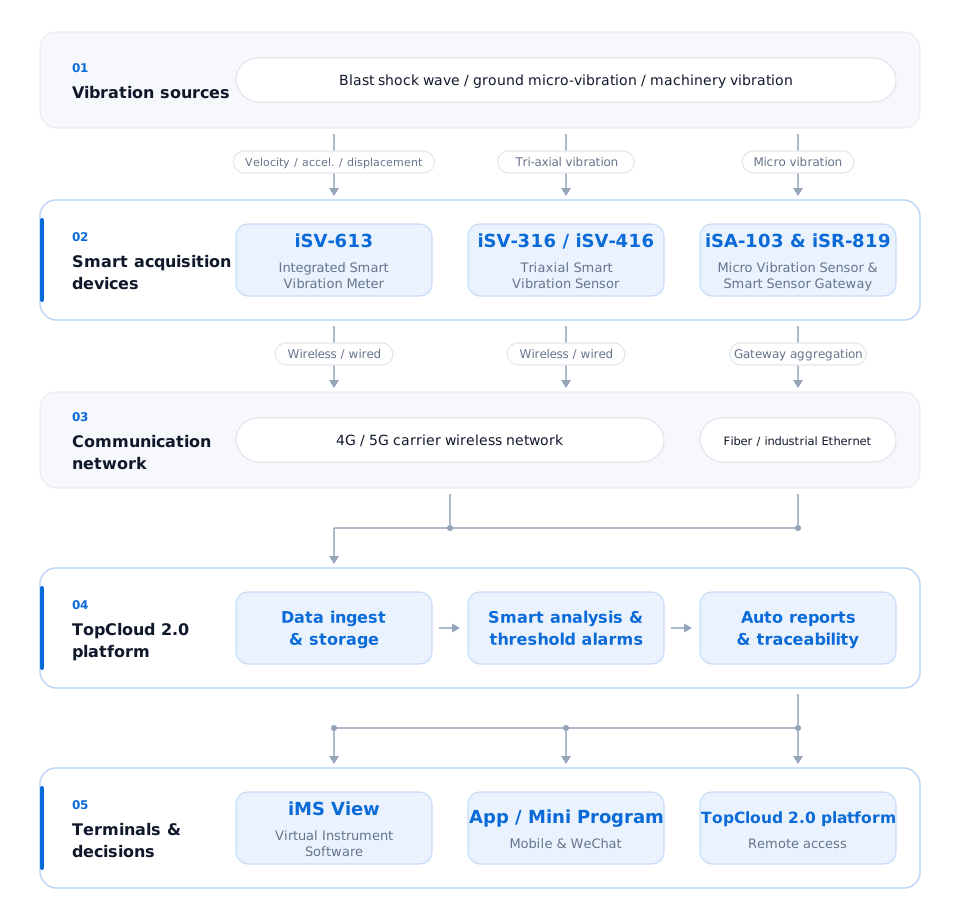
Geotechnical vibration monitoring system architecture: blast shock waves, ground micro-vibration and machinery vibration are captured by the iSV-613 Integrated Smart Vibration Meter, iSV-316 / iSV-416 Triaxial Smart Vibration Sensors and the iSA-103 Micro Vibration Sensor & iSR-819 Smart Sensor Gateway, sent over 4G/5G carrier networks or fiber/industrial Ethernet to the TopCloud 2.0 platform for data ingest and storage, smart analysis with threshold alarms, and automatic reports with traceability, then presented in iMS View Virtual Instrument Software, the app / WeChat Mini Program and the TopCloud 2.0 platform.
Related equipment
Product Application Papers
Summary
- Authors
- 李飞
- Source
- 东北大学 · 2021
- Keywords
- 爆破振动;监测系统;数据监测与传输;监测数据管理与可视化
针对金属矿山爆破振动监测多靠临时布点、人工回收数据、效率低且难以长期监测的问题,设计并实现了一套面向矿山现场的爆破振动实时监测与数据管理系统,涵盖监测设备选型集成、采集软件开发、采集精度测试以及数据管理与可视化。
Summary
- Authors
- 杜瑞锋、裴向军、贾俊、张晓超、杨帅
- Source
- 土木工程学报 · 2021
- Keywords
- 地质工程;软弱夹层;爆破地震波;峰值加速度;试验研究
通过混凝土基座加边坡模型的物理模拟试验,改变炮孔位置和药量进行多次爆破,测量坡体速度与加速度响应并做频谱分析。结果表明软弱夹层具有吸能减震作用,而其上方的硬岩层会放大加速度,据此建立了含软弱夹层边坡在爆破地震波下的受力与滑动机理模型。
Summary
- Authors
- 张琪帆
- Source
- 山东科技大学 · 2019
- Keywords
- 爆破;冲击波;隧道;防冲台车
结合理论推导、现场测试与LS-DYNA数值模拟,对比研究炸药在空旷区域与隧道等受限空间中爆炸冲击波超压随爆心距的衰减规律,修正了空旷区域的衰减公式,并据此设计隧道爆破冲击波消减设备。
Summary
- Authors
- 黄猛猛
- Source
- 安徽理工大学 · 2025
- Keywords
- 地应力;切缝爆破;爆破增透;裂纹扩展;损伤特征;数值模拟
针对深部高瓦斯低透气煤层的增透需求,综合理论分析、爆破相似试验与数值模拟,研究地应力场与切缝爆破耦合作用下煤体的定向起裂机理、裂纹扩展模式和损伤分布,分析了侧压系数变化对炮孔周围应力分布的影响。
Summary
- Authors
- 张鑫
- Source
- 安徽理工大学 · 2025
- Keywords
- 地应力;爆破致裂;裂隙扩展;控制孔;相似模拟
面向深部高瓦斯低透气煤层的预裂爆破增透,综合理论分析、相似模型试验与数值计算,开展地应力作用下的单孔、单孔加控制孔、切缝及双孔爆破试验,揭示地应力对煤体损伤与爆破裂隙演化的影响。
Summary
- Authors
- 张先跃
- Source
- 安徽理工大学 · 2025
- Keywords
- 顶板爆破;坚硬煤层;松软煤层;爆破增透
分析爆破应力波与振动加速度在煤岩体中的传播及裂隙演化,在实验室搭建爆破相似模拟试验系统(含 VIB-4000E 高速数据采集仪、超声波CT等),结合数值模拟研究爆破动载下不同强度煤岩的裂隙扩展规律。
Summary
- Authors
- 于洁
- Source
- 东北大学 · 2018
- Keywords
- 深埋硐室;岩爆;爆破振动;数值模拟;振动响应
以锦屏深部地下实验室开挖爆破诱发岩爆为背景,用 ANSYS/LS-DYNA 建立实验室与交通洞的三维整体模型,模拟爆破振动传播并与现场实测振速曲线对比验证,进而分析初始地应力对岩爆区围岩动力响应的放大作用,探讨岩爆诱因。
Summary
- Authors
- 石晨晨
- Source
- 昆明理工大学
- Keywords
- 爆破空气冲击波;井下巷道;现场监测;数值模拟;破坏效应
结合理论分析、现场监测与数值模拟,研究井下大爆破空气冲击波在直巷、转弯、岔口和变截面巷道中的传播规律,用实测数据优化峰值超压预测公式,得到各类巷道的超压衰减系数,并给出爆破网路与作业人员的冲击波安全距离参考值。
Summary
- Authors
- 周明
- Source
- 南昌大学 · 2021
- Keywords
- 量纲分析;参数拟合;震动衰减;降噪;时频分析;App Designer
研究水下爆破引起的堤岸震动:用量纲分析建立考虑水、土介质的震动强度表达式,结合实测数据以非线性回归和遗传算法拟合并与萨道夫斯基公式对比;采用经验模态分解—小波阈值法降噪、分析震动信号时频特征,并开发了爆破震动分析软件。
iSV-316Mechanism of Axial Chain Rockbursts in Deep Tunnels: Structural Plane-Induced Stress Concentration Triggered by Drilling and Blasting (Li H P et al.)
Summary
- Authors
- Li H P, He B G, Feng X T
- Source
- Rock Mechanics and Rock Engineering · 2025
Using 3D in-situ stress inversion, geological survey, microseismic monitoring, numerical analysis and true-triaxial tests, the paper explains axial chain rockbursts in deep tunnels: they occur where structural planes dip near the major principal stress and strike nearly parallel to the tunnel, with drill-and-blast disturbance opening cracks ahead of the face; inclined planes markedly reduce rock strength and energy storage. The link points to a Chinese-language digest on WeChat.
Summary
- Authors
- 魏标、程尊伟、杨峰、吴敬飞、冯鹏
- Source
- 声学与振动 · 2015
- Keywords
- 微差爆破;装药量预测;主振频率;振动强度
针对传统微差爆破装药量经验公式只看振速、不计频率的不足,对《爆破安全规程》的振速—频率安全标准做线性化处理,提出同时考虑振动强度与主振频率的最大装药量计算方法,并在兰渝铁路编组站爆破工程中用拓普测控爆破振动监测仪的实测数据加以验证。
Summary
- Authors
- 石月晴、游克勤
- Source
- 水利水运工程学报 · 2018
- Keywords
- 边坡桩基;黏土强度;应力组合;静动力试验
以重庆来福士广场西侧黏土边坡为背景,用拓普测控 NUBOX-6016 测振仪配超低频传感器实测冲击钻成孔抗滑桩施工引起的地表振动,再据现场动应力特征做室内静、动三轴试验。结果显示地表最大振速约 2 cm/s、离桩 26 m 处仍可测到振动,土体动强度明显低于静强度,建议施工期综合强度折减系数取 0.7~0.8。
Summary
- Authors
- 杜汉庆
- Keywords
- 爆破震动;质点速度;衰减规律;震动控制
在水电工程现场的多组岩石爆破试验中(含路堑小孔径爆破和边坡预裂爆破),用 UBOX-20016 记录仪配速度传感器测量多个测点的质点峰值振速,分别拟合衰减公式的 K、α 系数。结果表明系数随孔径、装药密度和是否预裂而变化,预裂可明显降低振动。
Summary
- Authors
- 曾晟、杨仕教、谭凯旋、孙冰
- Source
- 采矿与安全工程学报 · 2008
- Keywords
- 爆破振动;振动速度;安全距离;微差爆破
为保证锡矿山浅层残矿回收时井下爆破不危及地表建筑,用 UBOX-20016 爆破振动测试记录仪实测地下爆破振速,分析振速与单段最大药量、爆心距的关系,给出微差间隔和单段装药量的控制建议。
NUBOXStudy on the Influence of the Blasting of Preceding Tunnel on the Pre-Penetration Surrounding Rock in Succeeding Tunnel with Small Clear Distance (Xiankai Bao et al.)
Summary
- Authors
- Xiankai Bao, Wu Zhang, Shuang Zhao, Chaoyun Yu, Yongjun Lü, Shurui Wang, Ning Wu
- Source
- Shock and Vibration · 2022
Based on field monitoring at the Kaifeng Mountain small-clear-distance tunnel with UBOX-20016 portable acquisition equipment, the authors derive a velocity–distance relation from energy attenuation, predict peak vibration in the succeeding tunnel's pre-penetration rock, and use numerical models of velocity, plastic strain and stress to identify the critical section and minimum safe clear distance.
Summary
- Authors
- Liu Han, Jisen Shu, Yanjun He, Tao Chen, Changchao She
- Source
- International Journal of Circuits, Systems and Signal Processing · 2020
- Keywords
- signal processing; blast vibration; multipoint blasting; slope; accumulative deformation
To study cumulative deformation of a soft-rock dump slope under repeated blasting, the authors build a vibration-displacement formula and a superposition model for stress waves from multiple sources, record blast vibration on the gangue slope of Lijiahao Coal Mine with a UBOX-20016 vibration signal recorder, and simulate the resulting displacements. Vertical displacement decays logarithmically with distance while horizontal displacement changes little; more simultaneous shot points cause larger deformation, so staggered multipoint firing with controlled delays effectively limits slope deformation.
Technical questions
How should velocity and acceleration instruments be selected for geotechnical vibration?
iSV-613 I/E/A models support internal, external or both sensor configurations respectively. iSV-316 and iSA-416 measure acceleration and compute velocity, while iSV-416 measures velocity and computes acceleration. iSA-416 and iSV-416 share one product page with a model comparison. Select the measurement chain for the required quantity and frequency response.
Context and configuration
For blasting, distributed vibration measurement and infrastructure monitoring, compare the individual specifications. The L-type ranges below retain their measured quantities and calculation relationships.
Specifications and conditions
- iSV-316 Triaxial Smart Vibration Sensor · Measurement Performance · Range ±16 g (iSV-316L);Acceleration range; velocity is computed from acceleration
- iSV-416 / iSA-416 Triaxial Smart Vibration Sensors · Measurement Performance · Range ±15 cm/s (iSV-416L)
- iSV-416 / iSA-416 Triaxial Smart Vibration Sensors · Measurement Performance · Range ±16 g (iSA-416L)
Application limits
Distinguish computed quantities from direct measurements. An L-type range does not describe an H-type variant or another instrument.
Related specifications
How should the iSV-613 range, bandwidth and sample rate be read together?
Check the range against vibration amplitude, bandwidth against the frequency range, and sample rate against its per-channel specification. Assess all three rather than sample rate alone.
Context and configuration
These are iSV-613 velocity measurement specifications. The maximum-bandwidth qualifier and the per-channel sampling qualifier are retained.
Specifications and conditions
- iSV-613 Integrated Smart Vibration Meter · Velocity Measurement · Full-scale Range ±30 cm/s
- iSV-613 Integrated Smart Vibration Meter · Velocity Measurement · Bandwidth 3 Hz–800 Hz
- iSV-613 Integrated Smart Vibration Meter · Velocity Measurement · Max Sample Rate 20 kSps
Application limits
Do not describe the maximum bandwidth as unconditional performance under every setting, or apply another instrument’s range to this device.
Related specifications
Under what conditions does the multi-unit iSV-613 synchronisation specification apply?
Read the synchronisation figure together with its timing condition: iSV-613 Integrated Smart Vibration Meter · Synchronisation & Sensor Input · Multi-unit Sync Accuracy 1 μs with BeiDou satellite timing.
Context and configuration
The iSV-613 uses satellite timing for distributed measurement. Consider the timing status when comparing waveforms across instruments.
Application limits
This figure does not establish the same accuracy without satellite timing and must not be strengthened to “sub-microsecond” or “better than 1 μs”.
Related specifications
What power and data links should be considered for unattended vibration monitoring?
The iSV-613 supports local storage, Wi-Fi and optional mobile communication, with TopCloud and mobile-app access. Plan power around its continuous-operation battery specification.
Context and configuration
Measurement data is transferred to the platform for storage, analysis and alarms. Check the selected communication configuration and power arrangement for the site.
Specifications and conditions
- iSV-613 Integrated Smart Vibration Meter · Mechanical, Power & Environment · Battery Life 16 hours
Application limits
Continuous-operation battery life is not a promise of indefinite unattended operation. Optional communication features are not included in every configuration.