

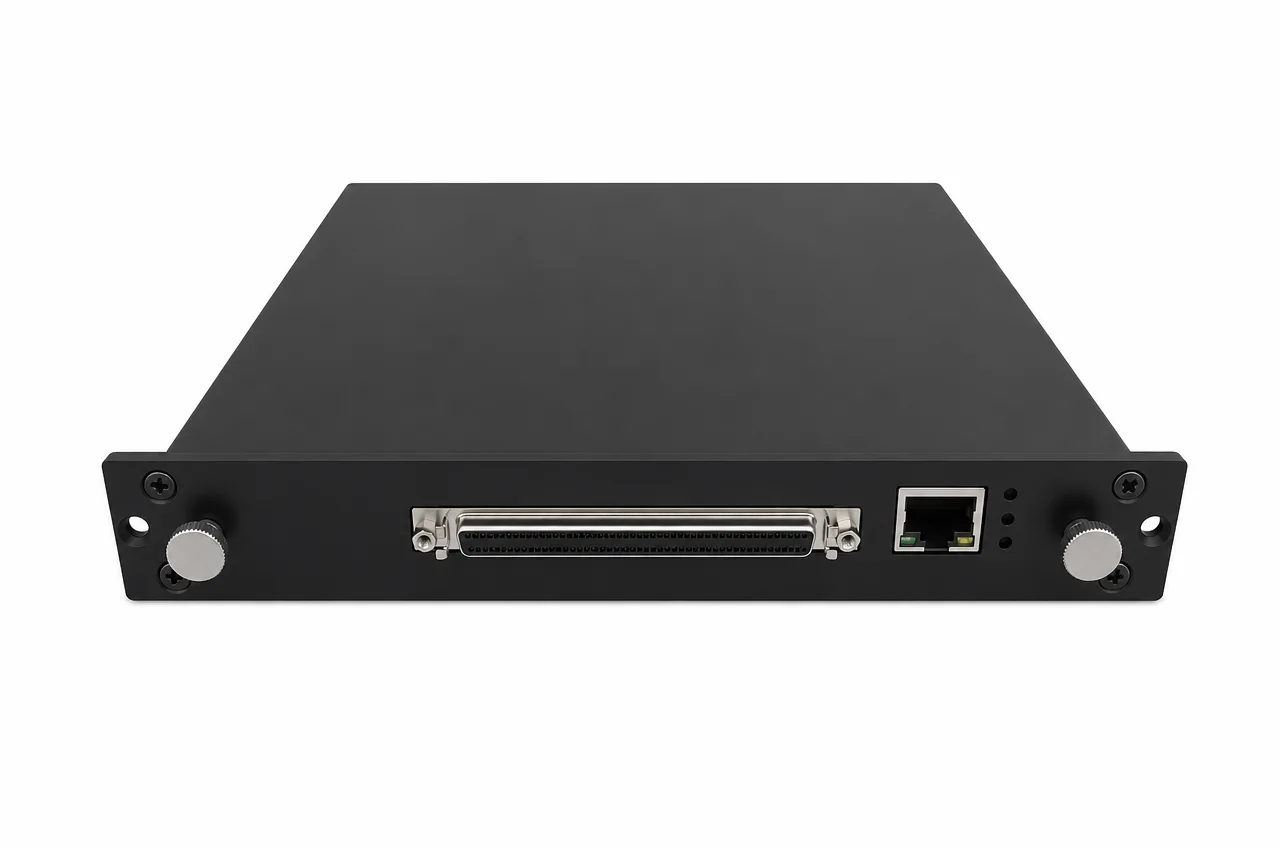
Serial / CAN Communication Module
- 16 full-duplex differential serial ports plus 4 CAN channels on one card — parallel multi-device testing from a single module
- Each serial port switchable between RS422 / RS485 / RS232 with an individually shielded ground; baud rate configurable 800bps~500kbps
- 4 CAN channels (2 dual-channel), configurable up to ≥1 Mbps, CAN2.0B with CAN2.0A compatibility
- Programmable auto-forwarding between serial and CAN — no host intervention required
- Date-based on-board storage with automatic capacity management, FTP retrieval and real-time forwarding to the zero-slot host
- All parameters saved automatically and reloaded at power-on; 100% domestic chips, running inside the chassis or standalone over gigabit Ethernet
Need selection advice or an on-site demo? Use the buttons above and our engineers will reach out shortly.
Specifications
| Item | Value | Note |
|---|---|---|
| Serial (RS422 / RS485 / RS232) | ||
| Channel Configuration | 16 full-duplex differential | |
| Interface Modes | RS422 / RS485 / RS232, switchable | Switched per port |
| Shielded Ground | Individually shielded ground per channel | |
| Baud Rate | 800bps ~ 500kbps, configurable | |
| Frame Format | Configurable data-bit length, stop bits and parity | |
| CAN | ||
| Channel Configuration | 4 channels (2 of them dual-channel) | |
| Protocol Standard | CAN2.0B (compatible with CAN2.0A) | |
| Baud Rate | Up to ≥1 Mbps, configurable | |
| Data Handling & Storage | ||
| Parameter Setup | Configured independently per serial port and CAN channel | |
| Auto-Forwarding | Programmable auto-forwarding between serial and CAN | |
| On-Board Storage | Serial and CAN data stored by date, capacity managed automatically with the oldest data discarded when full | |
| Data Retrieval | Retrievable over FTP and similar | |
| Host Forwarding | Two-way forwarding with the zero-slot module (host) | |
| Parameter Persistence | All parameters, baud rate included, saved automatically and reloaded at power-on | |
| Platform Common Characteristics | ||
| Mounting | Front-inserted card, quickly swappable | |
| Standalone Use | Detachable from the chassis for standalone use over gigabit Ethernet | |
| Backplane Communication | Power, command, synchronization and status signals unified over the backplane | |
| Localization Rate | 100% | |
| Component Temperature Grade | -40℃ ~ 85℃ wide temperature | |
FAQ
- Does serial↔CAN forwarding require the host?
- No. Auto-forwarding between serial and CAN runs on the module itself, with the forwarding map configured programmatically. The host only pushes the configuration — the forwarding path neither occupies the host link nor depends on host load. Data can be forwarded to the zero-slot module (host) in parallel for real-time processing.
- Where does long-run test data go, and can storage fill up?
- Serial and CAN data are stored locally on the module in date-based files, with capacity managed by the module itself — the oldest data is removed automatically when space runs short, so long unattended runs are not interrupted by a full disk. Stored data can be retrieved over FTP and similar means.