

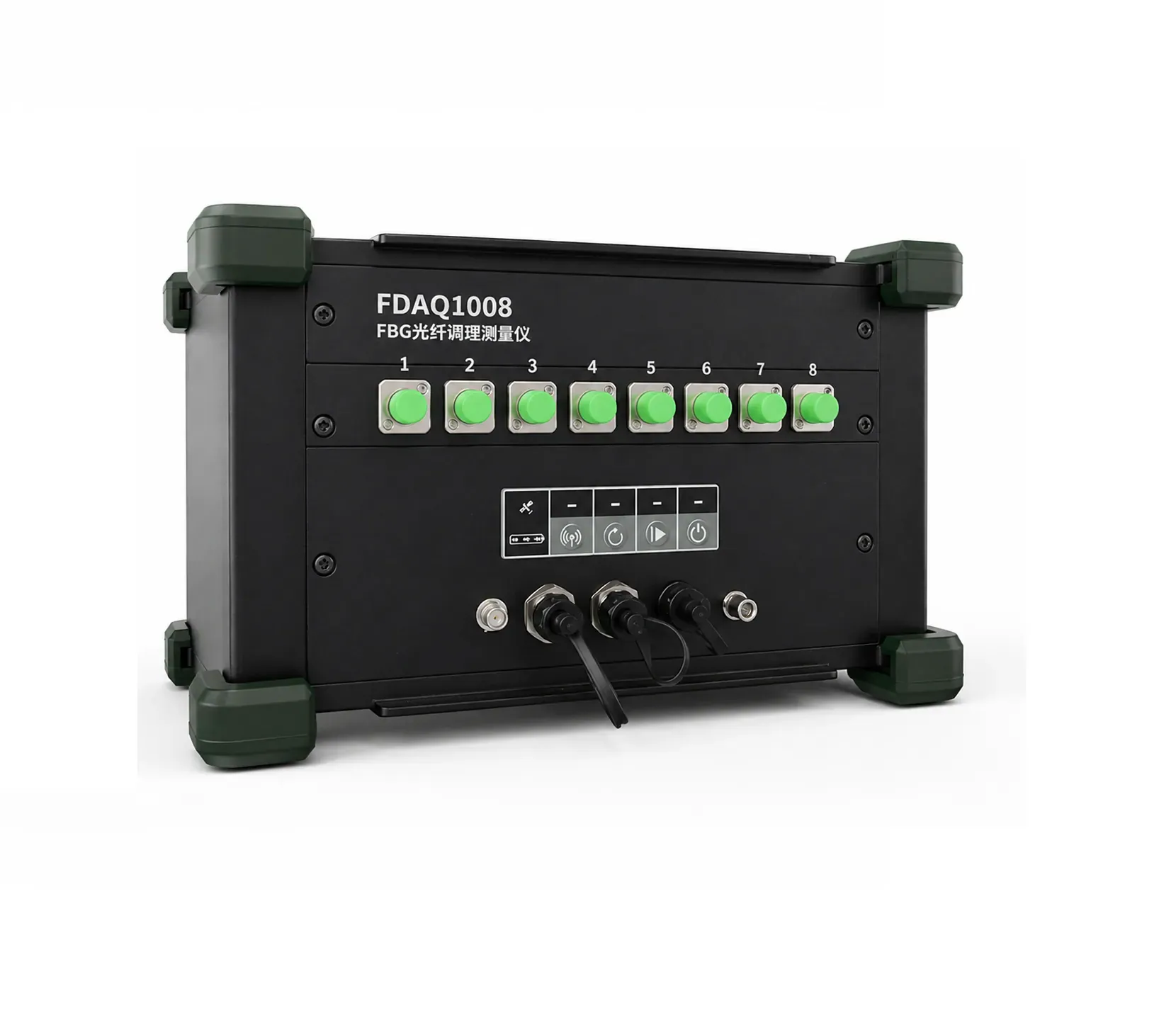
FDAQ-1008
- Multi-channel FBG fibre-grating interrogator with built-in broadband source; diffraction-grating spectroscopy for reflected-spectrum measurement
- 0.2 pm wavelength resolution, 1 pm repeatability, 2 pm accuracy
- 300/200 Hz scan rate for dynamic monitoring and quasi-static measurement
- Up to 128 sensing points (16-CH version); synchronous multi-parameter monitoring
- EMI-immune, withstands high temperature/pressure and corrosion for harsh industrial environments
- Passive sensing (no field power), fanless with no moving parts, long life and calibration-free
Need selection advice or an on-site demo? Use the buttons above and our engineers will reach out shortly.
Specifications
| Item | Value | Note |
|---|---|---|
| Optical | ||
| Wavelength Range | 1525–1565nm | |
| Light Source | Built-in broadband source (diffraction-grating spectroscopy) | |
| Channels | Up to 16 channels (16-CH version) | |
| Sensors per Channel | Typically 8 | |
| Max Sensing Points | 128 (16-CH version) | |
| Measurement Performance | ||
| Wavelength Resolution | Down to 0.2 pm | |
| Wavelength Repeatability | 1pm | |
| Wavelength Accuracy | 2pm | |
| Scan Rate | 300/200Hz | Mid-to-high speed captures mid-frequency vibration signals |
| Strain Sensitivity | Approx. 1.02 pm/με | |
| Temperature Sensitivity | Approx. 11.5 pm/℃ | |
| Measurands | Synchronous monitoring of temperature, strain, pressure and more | |
| Temperature Compensation | Real-time | |
| Environmental & Reliability | ||
| EMI Immunity | Suitable for strong-EMI environments | |
| Durability | Withstands high temperature/pressure and corrosion harsh-industrial ready | |
| Sensing Mode | Passive sensing, no field power required | |
| Construction | Fanless design, no moving parts | |
| Maintenance | Calibration-free, long service life | |
Related scenarios
Downloads
FAQ
- How does the FDAQ interrogator work?
- The interrogator uses a built-in broadband source and scans the 1525–1565 nm band. When an external quantity deforms the grating and shifts its reflected wavelength, the device measures the centre-wavelength change of the reflected spectrum via diffraction-grating spectroscopy and converts it to strain, temperature or pressure through calibration.
- How many sensing points can one FDAQ support?
- Each channel typically chains 8 FBG sensors; the 16-channel version supports up to 128 sensing points per unit, with synchronous monitoring of temperature, strain, pressure and more.
- Does the FDAQ require periodic calibration?
- No. The FDAQ is fanless with no moving parts and provides real-time temperature compensation, so it requires no periodic calibration. The sensing end is passive and needs no field power, making it ideal for long-term health monitoring.